
If you have an anxious or shy cat, you already know the trickiest part: most advice about “warming up a cat” assumes a kind of patience that nobody teaches and most sitters don’t actually have.
You’re probably the only person who knows the precise way your cat hides when something is off. You know the difference between “ignoring me out routine or quiet time” and “ignoring me because they’re scared.” You know that the wrong houseguest, the wrong sitter, or the wrong day can mean two weeks of recovery on the other side.
And yet most pet care advice for cats still treats them like dogs with a smaller bark. They aren’t.
As an anxious cat sitter in Redwood City, here’s what I do at The Pet Bestie to help.
Anxiety in cats looks different from anxiety in dogs
From the outside, dogs tend to externalize a bit more than cats do. Of course there are outliers to that, but generally it’s the case. With cats, they can hide health problems and pain so easily that we miss it until the cat can no longer internalize their feelings. It’s why it’s vital that we know our individual cats, as well as what to look for that might subtly cue us that something is wrong.
A lot of what cats are doing is what Fear Free training calls FAS — fear, anxiety, and stress. The Fear Free framework, which I’m certified in, is about catching FAS early enough that a cat never has to escalate to telling you in bigger ways. The signals are there. They’re just quieter than what a dog might do.
I have looked after my fair share of medically complex and anxious cats. I have cared for multiple client’s cats who need chemotherapy, insulin shots, heart medication that has to be given every 12 hours… and the biggest lesson was that I had to understand the individual cat to then understand what I could do to decrease FAS signals. For a cat named Pebble, that meant that I needed to attempt to give her some of my ear wax out of my own ear (I know, maybe a little gross, but it worked). That happened because I needed another option that the owner could tell me about to help medicate her for a heart condition without stressing her out, and utilizing positive before and after things for her. That meant that the owner said “well, it sounds weird, but she loves ear wax. Let’s have you try it”. So I did.

The fundamental shift: pace, not push
The first thing I changed about how I work with anxious cats — long before I had the formal training to put a name to it — was that I stopped trying to get them to be more comfortable with me faster. That is never a strategy that works, and always one that will consistently stress a cat out.
If a cat doesn’t come out from under the bed, that’s ok! I will not force them to come out. I will make sure I know where they are and where their hiding spots are, but I will continue to be patient and try and utilize high value toys, treats, and encouragement. Forcing the issue will only make the next visit harder, not easier.
The fastest way to build trust with an anxious cat is to have more patience and exposure over time than you think might be ideal.
The basics you might be missing
A lot of “anxious cat” behavior is downstream of environmental basics that get overlooked. Before I do anything else with a new client whose cat is showing FAS signals, I check for these:
- Wet food. Cats are obligate carnivores with low thirst drive. Dry food alone is not enough for most cats long-term, and chronic low-grade dehydration contributes to anxiety, urinary issues, and general unwellness. If you change one thing this year, get some wet food into the rotation.
- Real play. Not “leaving a toy out.” Active, interactive play with a wand toy or feather, mimicking the full hunting sequence — stalk, chase, kill, eat. Ten to fifteen minutes a day. This is one of the most underused stress-reducers in cat care.
- Enough litter boxes. The rule is one per cat plus one extra. Two cats need three boxes. Three cats need four. If your cat is using the wrong place to pee, the first question isn’t behavioral — it’s whether the litter situation supports them.
- Vertical space. Especially in multi-cat households. Cats need to be able to go up. Cat trees, shelves, the top of a bookcase — somewhere they can survey from. A cat without vertical options in a multi-cat home is almost always a stressed cat.
Medication for anxiety… let’s normalize it
If your vet has suggested medication for your cat’s anxiety or fear, that is not a failure on your part. It’s just medicine. The same as anything else they might prescribe.
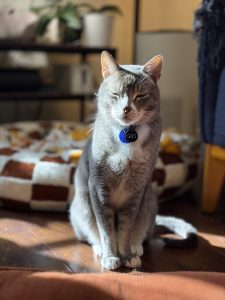
My own cat Gus is medicated. He’s behaviorally complex, and I don’t know his history because he is a rescue I quite literally found outside. The medication doesn’t make him a different cat, it gives him the space to be the cat he actually is without his nervous system getting in the way. A lot of anxious cats need that runway. There’s no shame in giving it to them.
If you’re considering it, ask your vet. If you’re already doing it, you’re doing the right thing.
The shorter answer
If you read all of this and recognized your cat somewhere in it, you’re already doing the most important part which is paying attention. The rest is just finding the right people, the right routine, and the right pace.
Anxious and shy cats don’t need someone to fix them. They need someone who can be patient, predictable, and paced to their comfort instead of to the clock.
If that’s the kind of cat sitter you’ve been looking for in Redwood City, San Carlos, Emerald Hills or the like… I’d love to meet you.
Reach out to me to talk. Our first call is free, and there’s no pressure to book if it’s not the right fit.